
 Facundo Iglesia
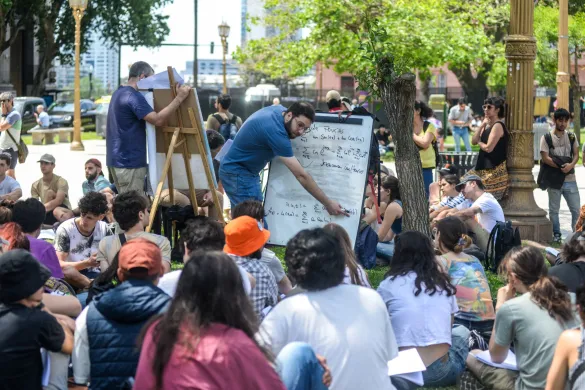
Algebra, software engineering, psychology, economics, statistics — on Tuesday, more than 100 university professors gave their lessons outdoors in Plaza de Mayo in Buenos Aires. The protest outside the Casa Rosada was part of a nationwide 48-hour nationwide strike against President Javier Milei’s government.
Teacher and student demonstrators were demanding salaries that keep up with inflation, following steep budget cuts that have greatly harmed their purchasing power.
Placards announcing the names of the classes being taught were dotted all over Plaza de Mayo. “Probability and Statistics, 4 p.m.,” said a handwritten poster plastered on a tree. A whiteboard announced a “Teaching Economics to Milei” class at 3 p.m.
“Most teachers earn a salary below the poverty line, and this has repercussions on very concrete issues — teachers are leaving the national universities to seek other opportunities, and this degrades the excellent education level,” said Martín Mansilla, an adjunct professor in Analysis I, from the Buenos Aires University’s mathematics department.
“What he is ultimately doing is bleeding out public universities little by little, which are super fundamental in this country,” added Mansilla, while getting ready to teach a course on local extrema and the Hessian matrix.
Mansilla told the Herald he earns AR$280,000 (US$241 at the MEP rate) for teaching eight hours a week, not taking into account the time spent preparing the lessons or correcting exams. “I think [Milei] does not realize what he is doing with the measures and especially the things he says. It is very difficult to be a scientist and a teacher and see the president of your country treat you like a plague,” he said.
The clash between the university community and the government started early once Milei took office, as salaries have lagged behind inflation. On October 9, Congress upheld Milei’s veto of a bill granting increased university funding. The day before the vote, the Ministry of Human Capital issued a 6.8% salary increase for university professors and staff via decree. The Argentine Federation of National University had been seeking 63.5%, claiming the figure represented the value lost to inflation since the administration took power in December.
Students from 60 universities have occupied the buildings in protest. “Although the president says that the public university will not be shut down, well, he is doing exactly that because without sufficient salaries, the human resources won’t be available and the university will not function,” said Mansilla. “Students know this.”
Medical residents set up a “health tent” in Plaza de Mayo where they taught about contraception methods and measured people’s blood pressure, among other things. Health workers also protested against the cuts by doing cardiopulmonary resuscitation (CPR) in front of the Casa Rosada on pillows representing public health, to “Staying Alive,” a song by the Bee Gees which, according to experts, is the ideal rhythm in terms of beats per minute to use for hands-only CPR. They playfully aimed to “resuscitate” public health and prescribed “a 100% wage increase” to do so.
“Us first-year residents earn below the basic basket. Today, we earn AR$740,000 (US$636) with workloads of more or less 90 or 80 hours a week,” said Ariana Devito, clinical resident physician at Hospital Posadas, which depends on the Health Ministry. The total basic basket for a four-member family, measured by the INDEC statistics bureau and taken as the poverty threshold, was AR$964,620 (US$830 at the MEP rate) in September.
Devito added that pay increases have been around 1 or 2% a month, while inflation last month — the lowest in Milei’s presidency — was 3.5%. She said that there had been talks about a pay increase under the previous health minister, Mario Russo, which ultimately fell through. Earlier this month, workers at the Laura Bonaparte Mental Health Hospital in Buenos Aires warned that the government had informed them that the inpatient and urgent care services were being shut down. Days later, after flash protests by the workers, the government clarified that the hospital would be “restructured,” but not closed down.
Devito said that the government aims to shut down national hospitals.
“With the increase in the cost of living for Argentines, people can no longer afford to pay for prepaid health insurance. So, all those people who used to go to private clinics end up coming to the public hospital,” said Devito, who was working in the health tent with the stated objective of bringing the hospital closer to the community.
At noon, President Javier Milei, who was celebrating his birthday, stepped out from a Casa Rosada balcony to wave his hand at the people in the square. However, after dodging police officers who were fencing the area, a crowd of protestors sang “University for the workers, and screw those who don’t like it” at the libertarian economist.
