
 Facundo Iglesia
An Argentine court will judge in absentia ten Iranian and Lebanese fugitives, accused of being involved with the AMIA bombing in 1994, federal judge Daniel Rafecas ruled on Thursday.
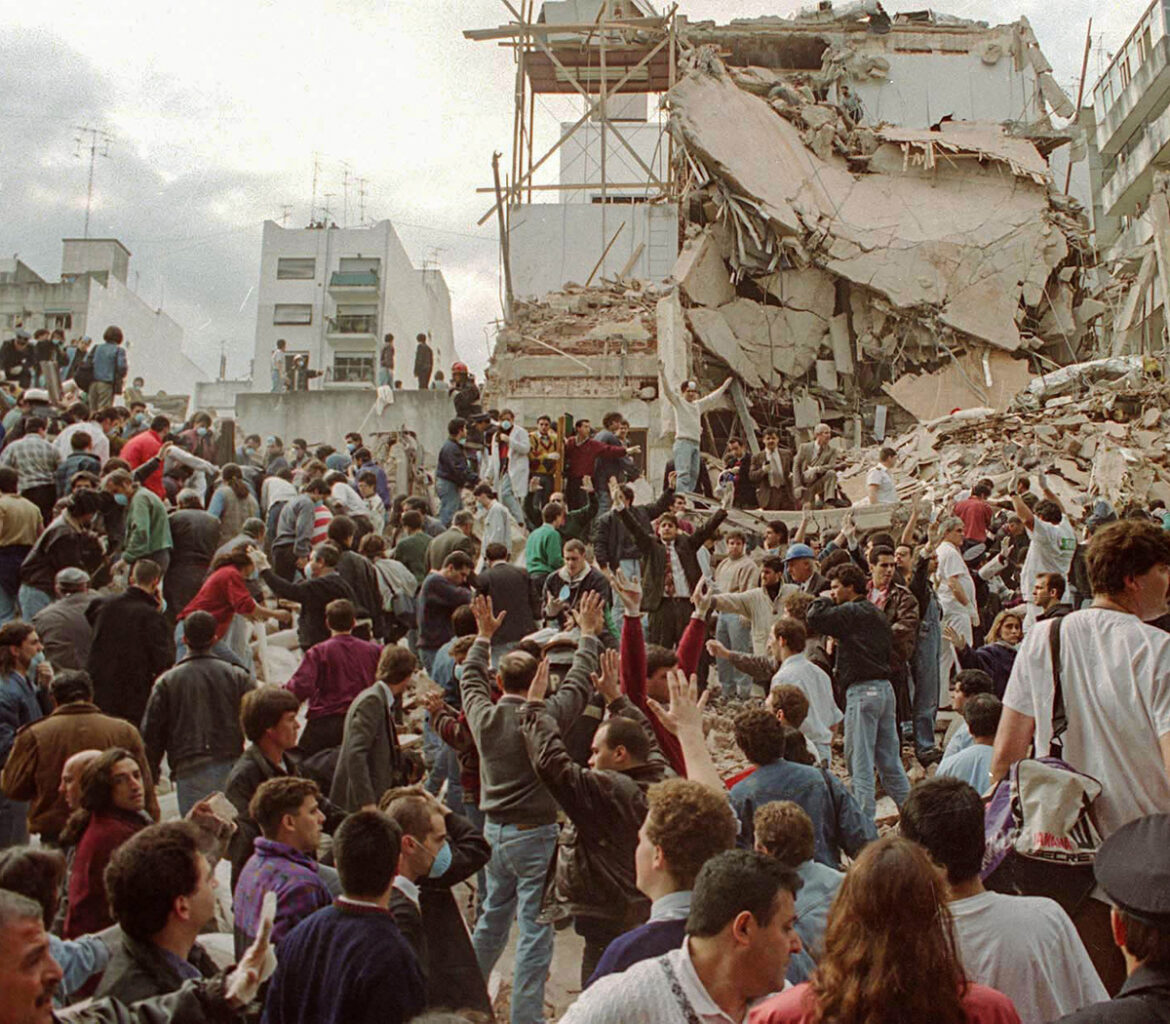
The main building of the AMIA, a Jewish community center in Buenos Aires, was destroyed by a bomb on July 18, 1994, killing 85 people and injuring over 300. Two years earlier, the Israeli Embassy in Buenos Aires also suffered a bombing attack that killed 22 people.
Rafecas issued a 148-page ruling, which the Herald had access to, after a request from Sebastián Lorenzo Basso, head of the AMIA prosecution unit. According to Basso, the AMIA bombing was perpetrated by the Hezbollah terrorist Lebanese organization, with the support of the Iranian government.
Basso said that a strategic plan was agreed upon in Iran in August 1993, with the presence of Iranian officials who were in Argentina before the attack, and that post-attack actions, such as cover-ups and obstruction of justice, took place. He added that the attack was conducted by a clandestine intelligence structure set up in Argentina in the 1980s.
The ten accused are Ali Fallahijan, Ali Akbar Velayati, Mohsen Rezai, Ahmad Vahidi, Hadi Soleimanpour, Ahmad Reza Asghari, Mohsen Rabbani, Salman Raouf Salman, Abdallah Salman, and Hussein Mounir Mouzannar.
Between 2006 and 2023, Argentina submitted extradition requests to Iran and Lebanon for the ten individuals, which have not been fulfilled. The accused have been declared in contempt of court by the Argentine judiciary and have remained fugitives ever since.
The investigation into the attack was hampered by corruption and cover-up attempts since it happened, and the case has become a divisive political issue in Argentina. A 2019 trial investigated the cover-up and convicted former judges and officials who initially investigated the attack. Former judge Juan José Galeano, Hugo Anzorreguy, who was in charge of the Intelligence Secretariat at the time of the bombing, and two former prosecutors were convicted for diverting the investigation to incriminate former police and disregarding evidence of Iran and Syria’s possible responsibility.
In 2013, during Cristina Fernández de Kirchner’s second presidential term, Argentina and Iran signed a memorandum of understanding that would have enabled Argentine prosecutors to interrogate Iranian citizens accused of involvement in the bombing. In 2015, prosecutor Alberto Nisman filed a lawsuit against Kirchner, alleging that the memorandum amounted to an impunity pact. In 2024, the Supreme Court ordered Kirchner to stand trial in that case.
Trials in absentia have only become possible in Argentina since January this year, after Congress passed a law allowing for trials of crimes like genocide, torture, and terrorism when the suspect is a fugitive.
Some organizations favored the accused to be tried in absentia, while others did not. The AMIA itself, together with the Delegation of Argentine Israelite Associations (DAIA), stated that such a trial would guarantee the international community’s interest in preventing and punishing terrorism and serious human rights violations. They added that the law allowing these kinds of trials “represents a significant progress for the victims, who demand justice, and for the State, which has the duty to provide it.”
Conversely, Memoria Activa, an organization of victims’ relatives, said that such a trial could be used to validate an “official version” of events without a full investigation. 18J and APEMIA, two other victims’ relatives’ groups, concurred. 18J argued that the trial would represent “an artificial closure of the investigation without reaching a true clarification of the facts,” while APEMIA said that it was built on the basis of “conjectures and insufficient and contradictory evidence.”
Public attorney Hernán Diego Silva, from the Federal Criminal and Correctional Matters No. 3, raised the unconstitutionality of the law allowing trials in absentia, an idea that Rafecas rejected in his ruling.
In the final words of the ruling, Rafecas acknowledged that previous investigations of the case had “irregularities,” but said that a trial in absentia “does not imply an automatic validation of everything done up to this point.”
“I know it is not easy to trust again,” he added. “I deeply understand the fear, the anguish, even the disillusionment that can be generated by the idea of going through a judicial process again, especially when there have been previous attempts that did not end as expected.”
However, he said that the new process will “be a new opportunity to control what has been done, to review what is missing, to demand what has not been fulfilled.”
