

 Buenos Aires Herald
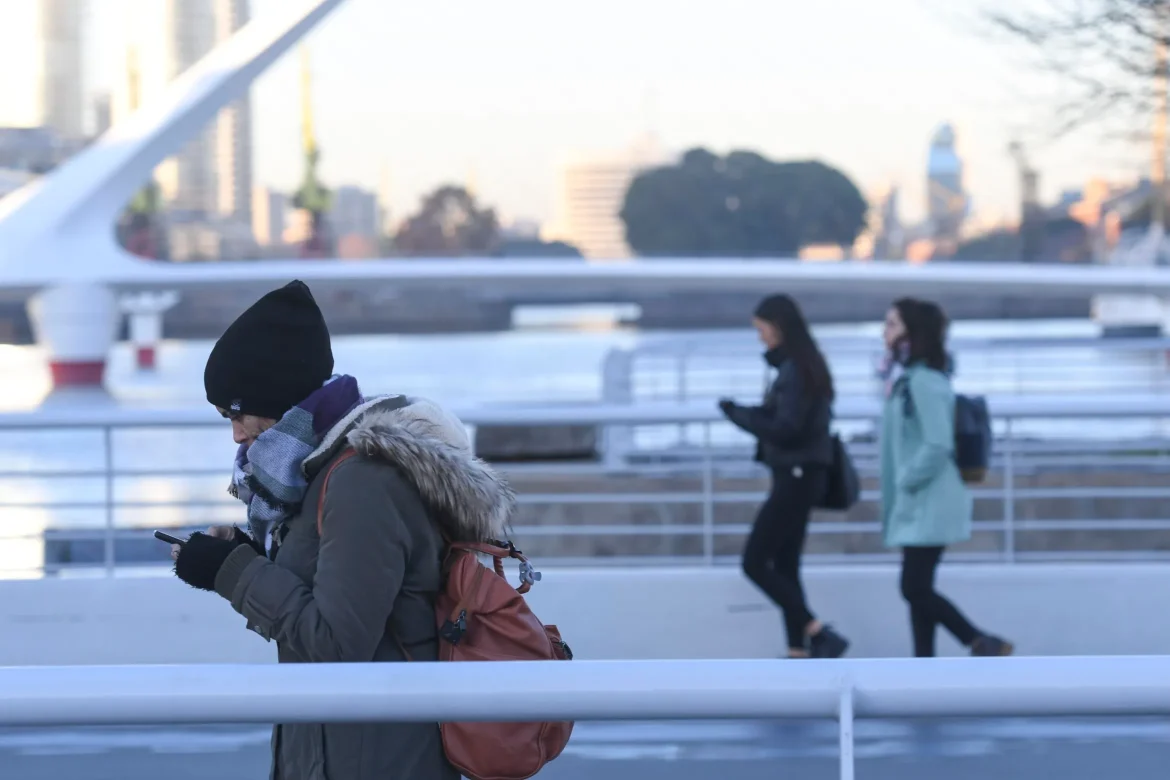
Baby, it’s cold outside.
A polar wave hit Buenos Aires and most of Argentina over the weekend, and the frigid weather is expected to persist through the middle of the week, according to the National Meteorological Service (SMN, by its Spanish acronym). Temperatures will range between 2 and 10 degrees Celsius in the capital, or 36 and 50 degrees Fahrenheit.
The cold has also brought precipitation to areas of the country that are not typically accustomed to it. In Trelew, a small city in northeastern Patagonia, it snowed for the first time in 12 years, while accumulations were also reported in areas of southwestern La Pampa, southern Buenos Aires, and some mountain ranges in Córdoba, as well as in Neuquén, San Juan, and Mendoza.
On Monday morning, the coldest city in Argentina was Maquinchao in Rio Negro province, which recorded temperatures of -16.2 degrees Celsius, or 3 degrees Fahrenheit, followed by Esquel, Chubut (-16 degrees Celsius), Malargüe, Mendoza (-15 degrees Celsius), Chapelco, Neuquén (-14.4 degrees Celsius), San Carlos de Bariloche, Rio Negro (-12.9 degrees Celsius).
Fortunately for local porteños, some warmer weather is on the horizon. Beginning Thursday, temperatures are expected to increase gradually, from lows of 4 to 8 degrees Celsius and highs of 13 to 17 degrees Celsius by the end of the week.
Cold days in schools
Public officials are taking the cold seriously. In Catamarca, Salta, San Juan and Tucumán, classes have been suspended, with the aim of preserving the health of students, teachers, and other staff.
“The measure applies to both public and private schools. The classes will be made up either in person or online during the second semester,” Susana Montoldo, the education minister of Tucumán, informed the newspaper La Gaceta.
Argentina’s proximity to Antarctica makes it uniquely susceptible to these kinds of cold waves. A weakening of polar vortices on the continent enables pockets of frigid, dry air to move northward, into more populated areas.