

 Ernesto Picco
 Words by Ernesto Picco. Photography by Rudja Santos. Cover illustration by Sebastián Angresano. Translated by Amy Booth and Jacob Sugarman.
This piece is the first in a series of three long reads about Guyana, French Guiana, and Suriname. It was reported with support from the Pulitzer Center. The full version was published in Anfíbia Magazine, in Spanish. Click here to read the original.
The countdown is in French. Trois. Deux. Un. Top!
Then, the bubbling of fire. A roar echoes through the jungle. The rocket takes off amidst dense bursts of gray smoke. In just a few seconds, it draws a white and yellow line stretching into the sky. It then makes like a parabola until it disappears into space.
Eighteen kilometers from the launchpad, in an amphitheater with fine red carpeting and leather seats, a crowd applauds. Among the joyful faces are politicians, scientists, and businesspeople. At the center of the room, a group of nervous engineers and assistants, seated with their backs to the audience, monitor giant screens displaying clocks, telemetry indicators, and live images of the rocket on its trajectory.

In the last row, next to the glass pane that separates them from the audience, is Stephan Israel. He is the chief executive officer of Arianespace, the world’s first commercial space transport company, which was founded in 1980. Israel is a clean, trim man of around 50, with narrow shoulders, a large head, and small glasses. Satisfied, he turns to his clients with a modest wave. Once a month, Israel travels 7,216 kilometers from Paris to French Guiana to attend each launch in person. Today’s was a success. That’s not always the case.
Four months later, in the same amphitheater, the scene is very different.
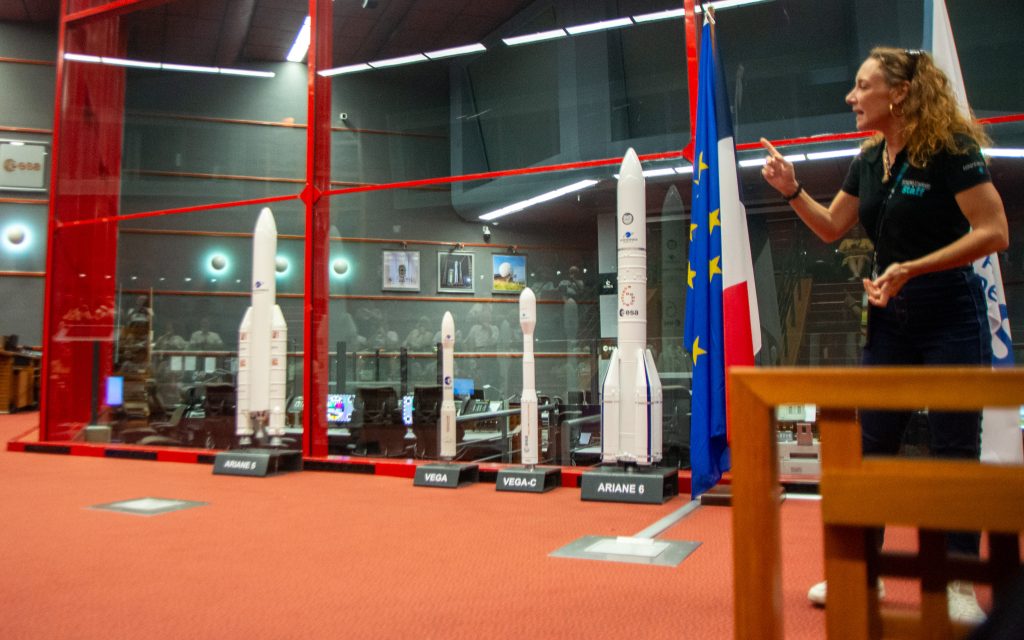
The control room is empty, and among the rows of leather seats, men in baseball caps and shorts, women with short hair, and young girls with blonde locks wander about. Alongside Rudja Santos, the photographer traveling with me, and a Mexican traveling alone, we are the only ones in a group of 40 who are not from France. The tourists take photos with models of different types of rocket and ask the guide questions. We have been touring the facilities of the Kourou Space Center for two hours and have only just been allowed to take out our cameras.
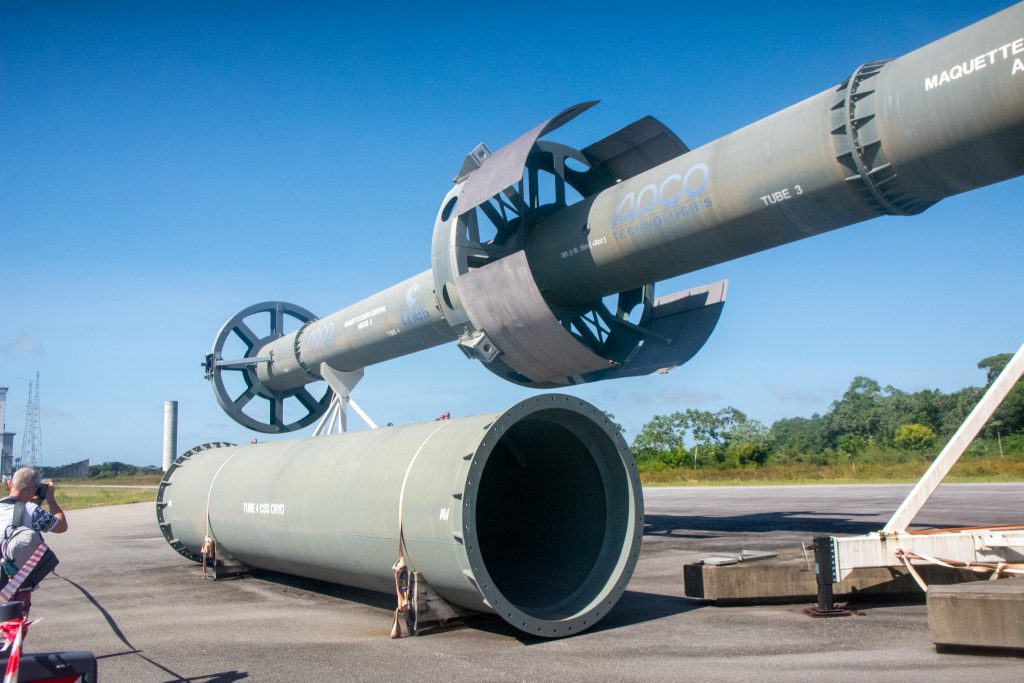
We have seen almost everything from the outside, riding on an air-conditioned bus, traveling along roads, paths, and roundabouts, surrounded by jungle that occasionally opens up to reveal imposing buildings. We knew what each thing was when they pointed it out to us: over there, a meteorological station; over there, a radar station; that’s a satellite preparation facility; and that, a gas and liquid propellant plant. We passed the perimeter fences, catching glimpses of several administrative control centers and three launchpads. The entire base is a fortress spanning 700 square kilometers — seven times the size of Paris, the guide proudly pointed out at the beginning.
From here, Argentina’s ARSAT-1 and ARSAT-2 satellites were launched in 2014 and 2015, along with dozens of other satellites and components for space stations, in operations involving governments and companies from various countries. The last major launch was in 2021: in cooperation with NASA, they sent the James Webb Space Telescope into space. It now operates 1.5 million kilometers from Earth’s orbit, studying the formation of the first galaxies and searching for life on exoplanets.
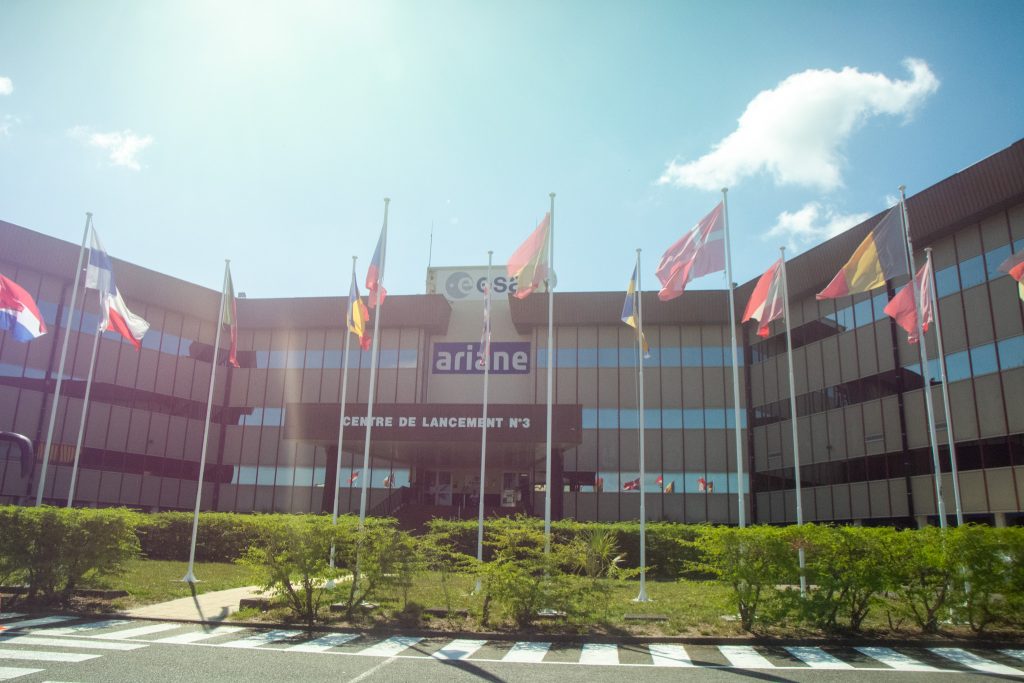
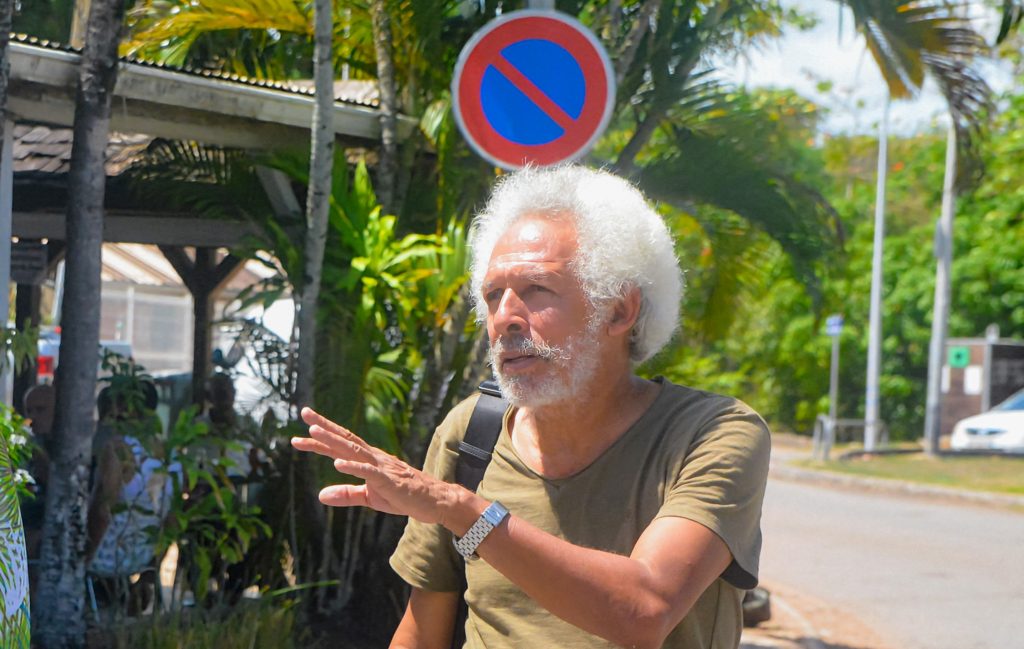
The guide explains that the French armed forces and the Paris fire brigade are stationed at the base. And then I recall my conversation with Maurice Pindard, one of the leaders of French Guiana’s independence movement. Maurice is a retired teacher, a thin man with white curls and a scruffy beard. He speaks perfect Spanish, only slightly dragging the guttural consonants of his French accent:
“The Kourou base is similar to the one in the Malvinas,” he told me. “It’s full of military personnel. That’s why we say what we have here is an advanced NATO base.”
But there’s something else. Perhaps something more fundamental — and no less opaque — that explains why France clings to this forgotten corner of the American continent. It doesn’t take long for us to understand it.
***
In January 1964, Pierre Chiquet and Raymond Debony arrived in French Guiana. Chiquet was the first engineer at the National Center for Space Studies (CNES, by its French acronym) and Debony, a colonel in the armed forces. They spent months on a mission trying to find a place to install the base they had to withdraw from the Sahara desert after Algeria became independent. They had examined negotiating with Australia and Brazil, as well as other French overseas departments.
Seventy kilometers north-east of Cayenne following the coastline, they found the ideal place to launch rockets into space between the cities of Kourou and Sinnamary. It offered a stable climate and proximity to the coast, but perhaps most importantly, its departing spacecraft could benefit from what is known as the slingshot effect: because the Earth’s rotation is fastest along the equator, any initial blast in its vicinity is significant enough to save money in fuel, while the rocket itself is able to carry a larger load.
Two months after Chiquet and Debony’s visit, General Charles De Gaulle himself traveled there and organized an elaborate ceremony in the streets of the capital to announce French Guiana’s “great transformation.”
There was just one problem: in the area where the government had decided to install the base, 105 Indigenous and Afro-descendant families had been living and cultivating the earth for generations. In March, 1964, they received a notification announcing that they would be relocated “for the benefit of CNES, with a view to establishing a space base.”
Almost 650 people were transferred in trucks to a shore beyond the perimeter of the site where the base would be built. As compensation, the government paid them money and gave them small, concrete houses. In return,they were forced to abandon their land, their animals, and the cemetery where their dead were buried.
Some adapted to a new way of life. Others resisted and ended up roaming the jungle, as had happened during the colonization of French Guiana and the construction of its penal colonies.
In 1967, after moving the families, the government built a hotel with a swimming pool, which housed the 3,000 workers who came from Europe to build the base, and a company town along the northeastern edge of the facility for local workers.
In 1970, the CNES launched the first rocket from Kourou. The Veronique was a 10-meter rocket sent into space to research the upper atmosphere and test guidance and navigation systems.
***
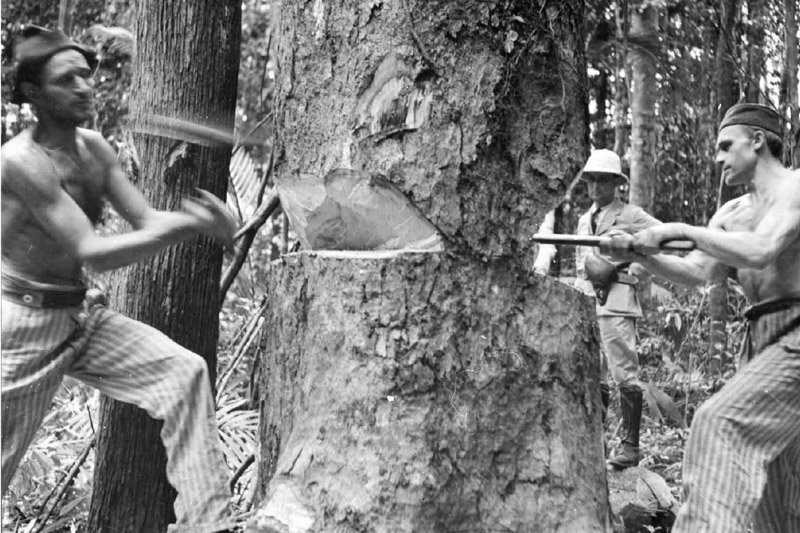
French Guiana used to be one large prison. Between 1852 and 1953, French political prisoners, recidivist thieves and other criminals were banished to a network of penitentiaries and forced labor camps that operated there. Most convicts were men, but there were a few women, too, of varying social classes. Nearly all of them were white.
Eighty thousand people were condemned and sent there during this period. Seventy thousand died of hunger, malaria, typhus, and yellow fever, or in brawls and escape attempts.
Between the seventeenth and eighteenth centuries, France occupied the eastern side of the Guyanas on the Brazilian border, animated by the tales of gold they could supposedly find there. The Indigenous peoples were forced back deep into the jungle while the settlers brought enslaved Africans to work the land.
They didn’t find the gold they were seeking, but they did set up large sugar plantations. When slavery was abolished in 1845, the freemen did the same as the Indigenous people: they escaped to the rainforest to form their own communities.
Then, the French brought immigrants from India and China as cheap labor. But sugar cane production didn’t work out, just as wood and pepper before it. So, the French government decided to use the distant land for something different, converting it into the enormous holding pen for lowlives that it would become for the next hundred years.
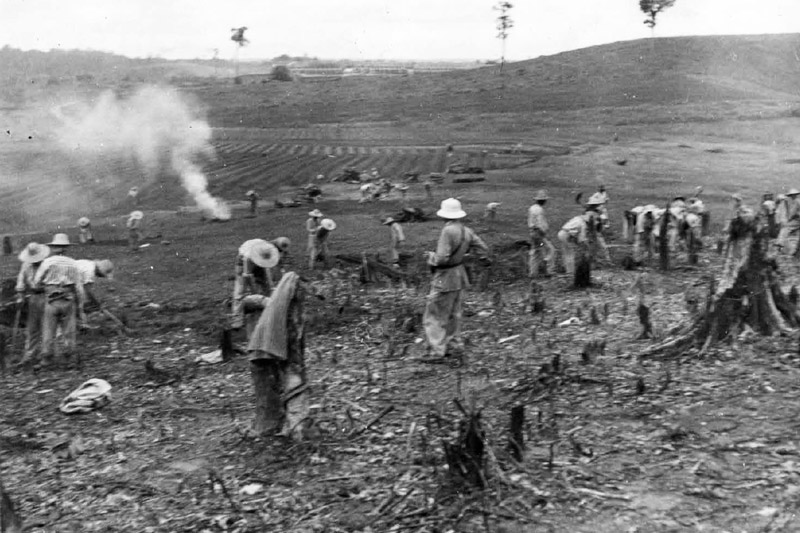
For decades, long lines of prisoners with red striped jackets and straw hats moved through the jungle, cutting wood and sugar cane, and watched over by prison guards in white uniforms. They slept in stuffy, crowded dungeons. Some died. Others held on. And just a few managed to escape.
At the end of the Second World War, the French government decided to close the prisons, which had developed a bad reputation in the press. Of the few thousand who were still alive, some prisoners were repatriated to European penitentiaries. Others were set free and left to their fate. Those who had the money could pay their way back to Europe. Still others — like the Indigenous peoples and freemen — escaped to the jungle. A number of inmates lost their minds and ended up wandering the streets of Cayenne and the smaller towns.
Over the following years, French Guiana was a hopeless backwater where not much happened, inhabited by campesinos of various ethnicities, meandering madmen, and jaded bureaucrats. In 1962, when Algeria won its war of independence against France, President Charles De Gaulle agreed to shutter the Hammaguir base — a center for testing military space vehicles that had been operating in the Algerian Sahara since the 1940s. And then the French remembered their land in South America.
***
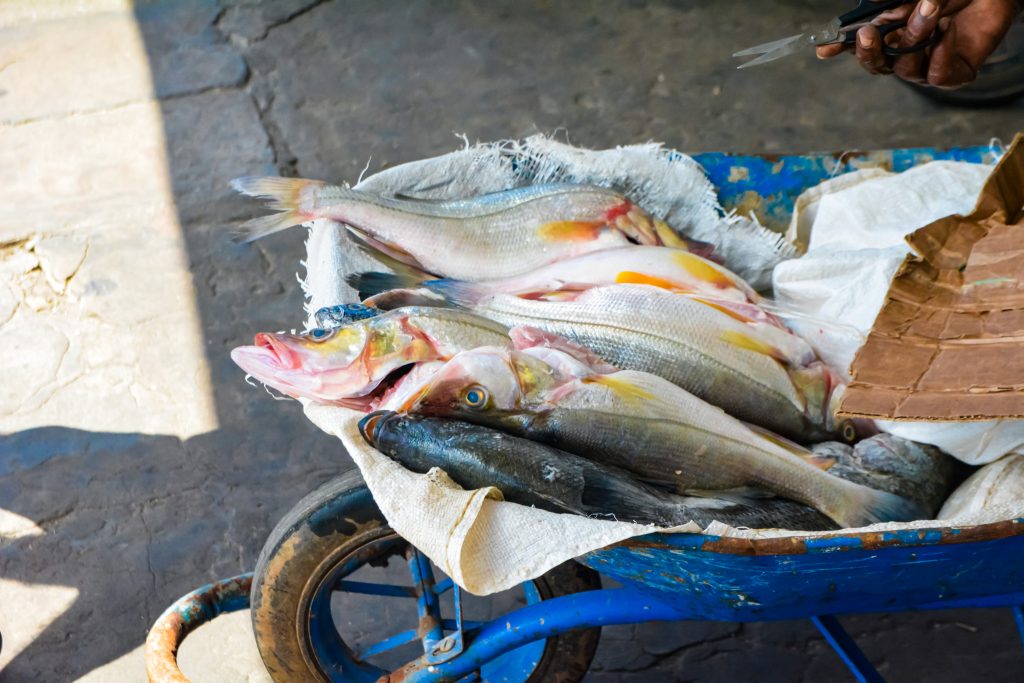
Eight kilometers from the border bridge is the town of Saint Georges de Oyapoque. There, people work as fishermen and small-scale gold miners, or dedicate themselves to moving people and products back and forth over the porous Brazilian border in little boats. A large part of what goes on there is illegal. On the river bank, where the boats come and go, a long line of minivans picks up travelers who, like me, are trying to get to the capital.
At 83,000 square kilometers, French Guayana is half the size of Uruguay and smaller than any country in the region. Ninety percent of it is covered by the Amazonian rainforest. Most of the population lives on a 380km strip of flat land along the Atlantic. There are no beaches; just sand banks and swampy ditches leading to the sea. A long highway extends the length of the country along the coast, and it is the most vital route to and from anywhere.
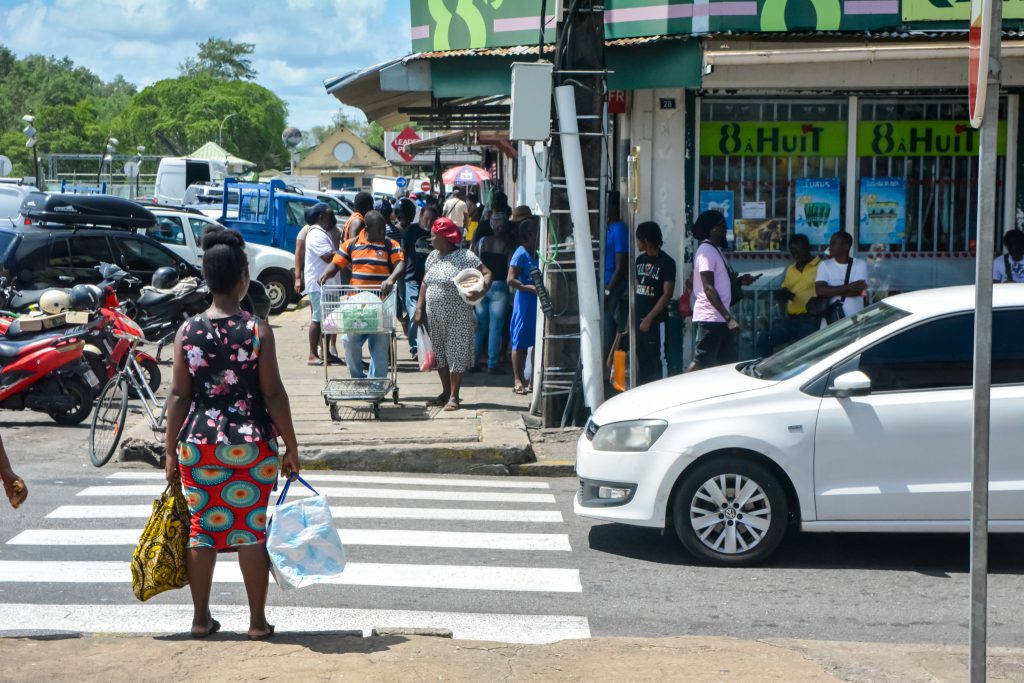
On the way into Cayenne, the traffic signs are styled like the ones in Paris, alongside billboards for major French brands: Carrefour supermarkets, Orange telecoms, Canal+ television antennas.
The political system that organizes life here is still colonial. The population votes for municipal mayors and other local authorities, and they form legislative bodies that develop administrative and service-related norms. But they cannot legislate on civic rights, criminal justice, or nationality. The Prefect, designated by Europe, has the final word on any decision.
The Guianese also elect two deputies in the French National Assembly, who travel to Paris as overseas representatives. Most decisions are made there, and this angers the French Guianese.
“The main fact is that France denies our existence as a people. As Guianese. And they say we’re French,” Maurice Pindard told me.
In French Guiana, there are at least seven Indigenous nations, each with its own language: the Wayana, the Apalai, the Kalina, the Wayampi, the Emerillon, the Arawak, and the Palikur. On top of this enormous diversity, which the metropolis seeks to assimilate under the umbrella of “French,” there are people of African descent; Chinese and Indian communities who arrived when slavery was abolished; Vietnamese communities who arrived in the 1970s; and currently, the hundreds of refugees who are fleeing wars in the Middle East.
This mélange ensures that Guianese identity is a little diluted, a little elusive. And this elusiveness, of course, creates problems.
***
Jean Víctor Castor wasn’t expecting the police, but in April 1997, they went looking for him at his home one morning. He was 35, and already an important union leader. After a series of investigations, authorities arrested and deported him to the island of Guadeloupe — another French overseas department 600 kilometers north of Cayenne — along with 11 other leaders with ties to independence movements.
The first independence movement was organized by high school students in November 1996. For four months, they skipped class and organized protests outside the Prefecture building over poor conditions and deficiencies in the curriculum. Everything they studied, they said, was packaged and sent straight from France, and there were no course materials that dealt with their lived experience. Soon, leaders from the Union of Guianese Workers joined them, and the marches became massive.
In late November, French President Jacques Chirac was forced to send his education minister and overseas territories minister to Cayenne. There, they negotiated to create a Rectorate of Guiana, which would administer education at a local level, and a 500 million-franc fund to refurbish schools.
Five months after the demands for educational autonomy began, the police took advantage of the relative calm to arrest Castor and his comrades, who had been in the crosshairs for a while because of their commitment to building an independence movement in the region.
These kinds of insurgencies were hardly new. In 1966, Guyana gained its independence from the United Kingdom and Suriname was heading in the same direction. In French Guiana, agricultors, fishers, construction workers, and public employees formed the Union of Guianese Workers. Together, they designed a flag with two triangles — one green and the other yellow — with a red star in the center. It would serve as a symbol of their demands for social justice, which were influenced by budding left-wing movements across the Caribbean.
A second generation of union leaders, including Castor, founded the Decolonization and Social Emancipation Movement (MDES, by its French initials).
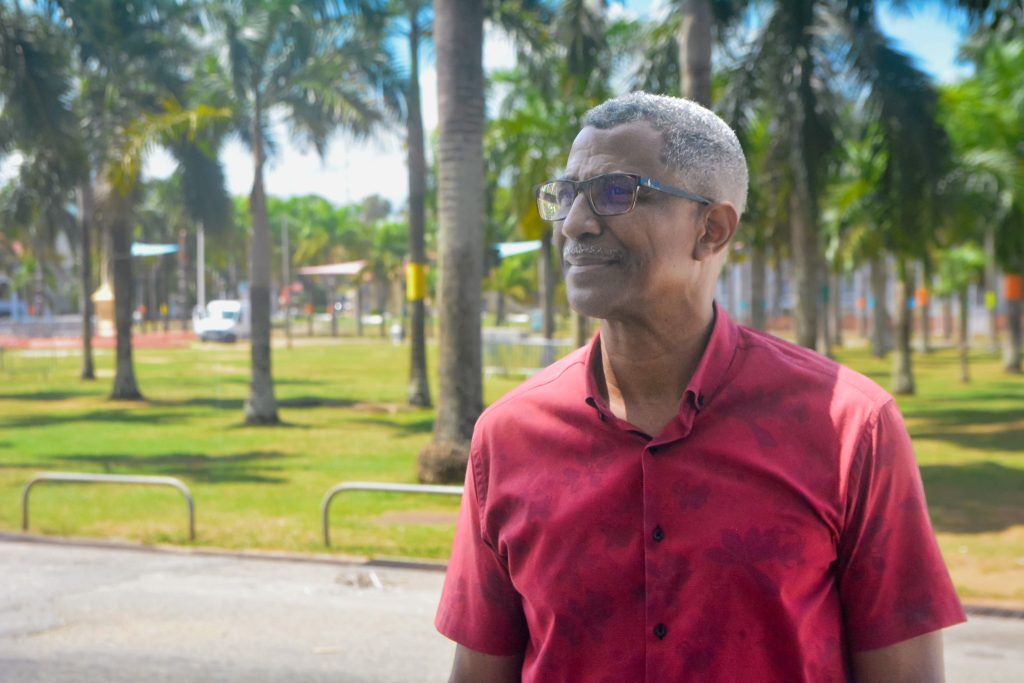
“Our formation was Marxist-Leninist,” Castor told me. “We fought against exploitation and for more autonomy. We wanted educational autonomy, but we also wanted to support agriculture, fishing, and all of the sectors that France can’t be bothered with.”
Around that time, Castor met Pindard, who was already a veteran leader. Pindard had left Guiana in the 1970s to study agriculture in the city of Le Havre. When he returned from France, he spent five years in an office for land management that depended on the central government. Eventually he resigned, sick of policies that didn’t consider the needs of local communities, and dedicated himself to working as a math and physics teacher as he organized for French Guiana’s independence.
“The problem is that 90% of the land belongs to the French state,” Pindard said. “And since the population lives near the jungle and can subsist on what it produces, there’s a demand to access land. But whoever wants to use it has to ask and request permission from the Prefect, and they don’t always allow it. It ends up being a really long and difficult process. We need land to produce more, and we need to live better.”
This is one of the biggest challenges for locals: the cost of living has always been high, because French Guiana produces almost nothing locally, save for a little fruit and fish. Most products come from Europe, and most are expensive because of the distance they must travel.
Shortly after MDES’ creation, it organized a strike with 22 picketlines across the territory to demand the French government build a road to Brazil. The route that was ultimately constructed has allowed the Guianese to shop for cheaper goods and seek healthcare. Previously, they had been isolated, only able to leave by plane if they had the money.
Despite the tendency to obscure local culture to blend it into that of France, in 2010 the Guianese took a key step toward forging their own nationality, at least in symbolic terms. The 56 members of the General Council and the Regional Council unanimously approved the green-and-yellow flag with a red star as their national symbol. It was the same one the Union of Guianese Workers designed in the 1960s.
The French government had no option but to accede, although it only recognized the design as a regional flag. For most Guianese, however, it has become a national emblem. Today, it’s even one of the flag emojis available on WhatsApp.
On French Guiana’s continuing path toward independence, one event has stood out from the rest: the great strike of 2017 protesting the levels of violence and the high costs of living.
During the year before, robberies, muggings, and other conflicts produced 42 homicides. The poverty rate was over 50%, and the cost of living had become impossible. Unions and the MDES took to the streets, as they had in the past. But this time, they were joined by an organization that had not existed until then.
The 500 Brothers Against Crime consisted of mostly Afroguianese men clad in black hoods from the marginalized neighborhoods of the capital. Demanding an end to the violence, they helped organize a general strike that paralyzed the country for 25 days between March and April. More than 40,000 people mobilized in Cayenne and thousands more in towns around the country. The Kourou space base was surrounded and forced to suspend its planned rocket launches. The Prefecture building was besieged. Schools stayed closed, and the teachers gave classes to the protesters’ children on the picket lines.
French President Francois Hollande decided to send Overseas Territories Minister Ericka Bareigts and Interior Minister Matthias Fekl. They spent days shut in, holding dialogues with the movement’s spokespeople.
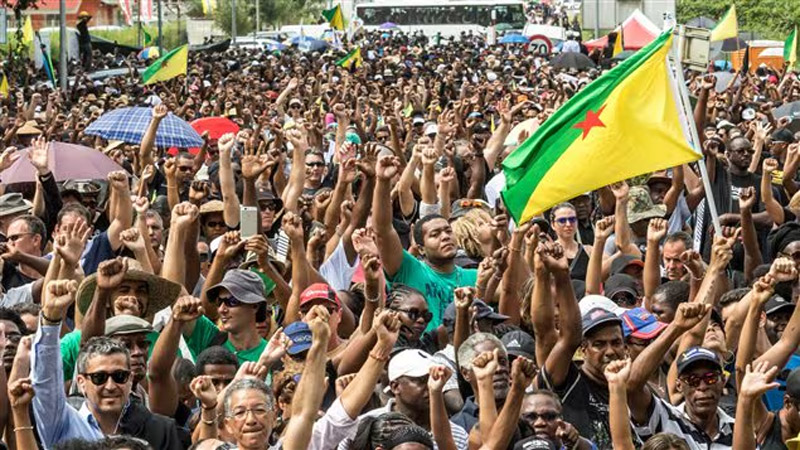
On April 21, 2017, Bareigts emerged on the Prefecture’s balcony, flanked by security guards and accompanied by Fekl. Her tiny body and thin face framed by short hair were scarcely visible behind the megaphone she used to address the crowd that surrounded the building. A warm rain had been falling. Thousands of demonstrators surrounded the building, awaiting responses with flags and colored umbrellas.
“For me, it is an honor to apologize to the Guianese people for the years of underinvestment in the overseas territory,” she said, her voice robotic through the megaphone.
The French government signed an agreement in which it promised to free up one billion Euros to finance projects to improve public security, healthcare, and the functioning of the justice system. The pact also aimed to stimulate the local economy and reduce unemployment.
The political impact of the new financing is still being felt. Thanks to the visibility they had garnered during the 2017 protests, the two deputies elected to represent French Guiana in the French National Assembly in the 2022 elections were both pro-independence.
In recent years, the police presence in Cayenne and towns in the Guianese interior has grown. Violence has fallen. But the economic situation still hasn’t changed. French Guiana remains a country that does not produce its own goods and depends on its metropolis to eke out a living.
***
Today, three agencies control the base: CNES; the European Space Agency, founded in 1975 and composed of 22 countries, whose main launch point is Kourou; and Arianespace.
When I quizzed the guide what it cost to launch a satellite into space from Kourou, she chuckled and asked if I had one to send. I persisted, and she finally answered: 250,000 euros per kilo.
The weight of a satellite varies considerably depending on its type and function, running anywhere from five kilos to several tonnes. Some of the heaviest recent launches include the Pleiades Neo, a series of four French satellites weighing 1,000 kilos each, the Korean KOMPTAT-2A (3,500kg), and Luxembourg’s Astra 3B (5,500kg). The James Webb telescope, which was launched in late 2021, weighs 6.2 tonnes. The Ariane 6, a 60-meter-long rocket, can carry up to 10 tonnes.
With an average cost of between 50 million and 200 million euros, these launches have become big business.
The base is likewise home to 41 companies that provide services encompassing everything from maintenance to research and tourism. These also benefit from the money that circulates there, accounting for around 1,600 workers between them. Most are super-qualified European professionals, who have installed themselves in the residential areas of neighboring Kourou.
That’s why Stephan Israel travels 14,000 kilometers round trip from France to attend each launch in person, greeting all of the station’s clients by name. And that’s why he stays with them when there are issues that delay or complicate their plans. This ambitious travel schedule will only grow more hectic if Arianespace increases its number of launches from 12 to 18 per year, as it intends to.
But beyond the neat, tidy microclimate of the base, French Guiana remains a corner of the world where time stands still — one that struggles to overcome economic, educational and security challenges that have plagued it for decades.
The oil boom in Guyana and Suriname, where growth is already visible and the future looks bright, has awoken suspicions within the independence movement in Cayenne. France is legally prohibited from drilling for oil in its overseas territories. But it is a French company, Total Energies, that has already broken ground in neighboring Suriname.
Shortly before departing on a fact-finding trip there, Pindard explained the trap in which the French Guianese find themselves.
“French doctrine maintains that the country mustn’t develop here, lest it interfere with the space base in France’s backyard,” he said. “That if they gave us independence today, we wouldn’t be able to sustain ourselves economically. Their companies can produce oil in other countries, but not here. Not us.”
“Because if the country develops, people will think of independence.”