
 Martina Jaureguy
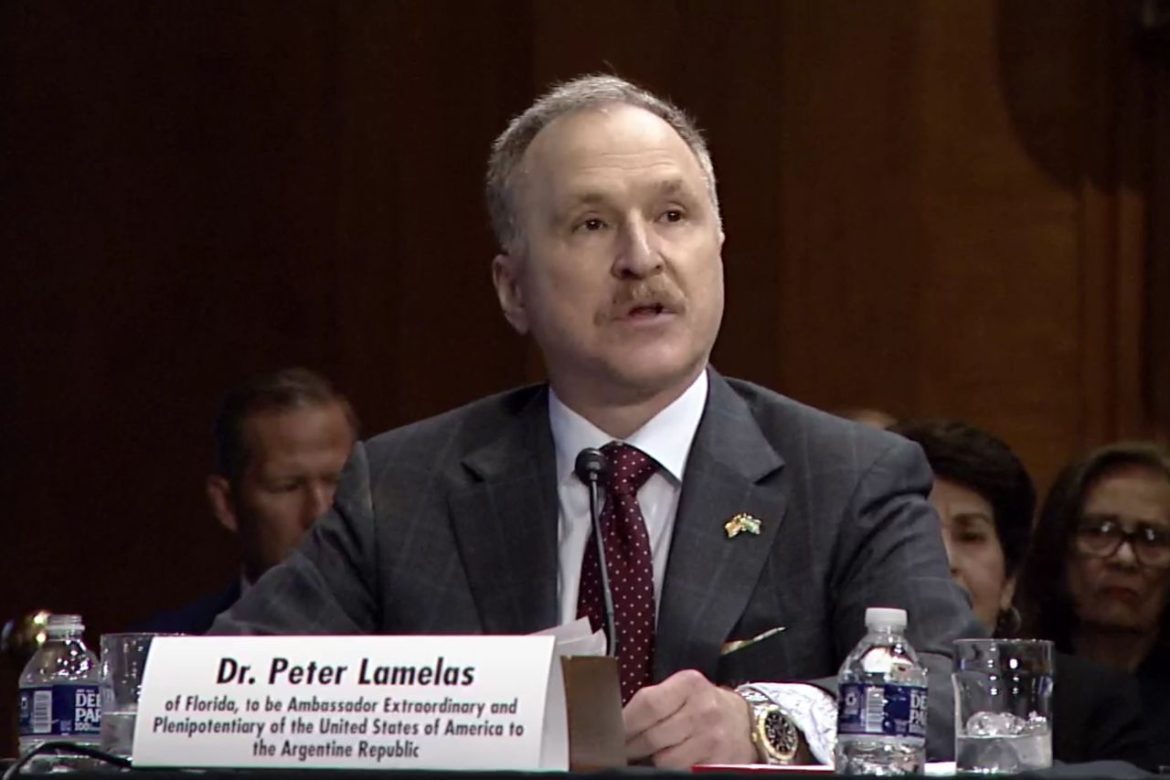
 Cuban-born physician and healthcare industry businessman Peter Lamelas appeared before a United States Senate committee on Tuesday to defend his nomination as ambassador to Argentina. Among the main issues he would focus on, Lamelas mentioned lowering trade barriers between the two countries and promoting dialogue over Malvinas sovereignty.
“The United States and Argentina share close economic, political, and cultural ties,” Lamelas said, calling Argentina “a key player in the Western Hemisphere” and describing its relation with the U.S. as “vital to regional stability.”
Lamelas made his presentation in a foreign relations committee hearing. The committee has to vote on whether to recommend the nomination to the full Senate, which will in turn confirm or reject the nomination through majority vote.
If his bid is approved, Lamelas will have to travel to Argentina and present his credentials to the local government before he can formally take on the post. There is still no timeline for when all this might occur.
Trump announced he would nominate Lamelas to the post in December, a little over a month before his inauguration. During Trump’s first presidential term, Lamelas served on the Department of Justice’s Medal of Valor Review Board and the Florida Board of Medicine. He was also Town Commissioner in Manalapan, Florida, and is the founder and former CEO of MD Now Urgent Care, one of Florida’s largest urgent care networks.
Lowering trade barriers is the goal
Speaking at the hearing, Lamelas said that the U.S. wanted to be Argentina’s “partner of choice” as it reopens to global markets. He went on to say that ensuring “lower trade barriers and secure partnerships” was Washington’s “strategic interest.”
He added that, if confirmed, he would “prioritize America first” and help create opportunities for United States businesses while working to “align Argentina’s and U.S. interests.” Lamelas also mentioned seeking cooperation to promote security and combat corruption.
The businessman said he was “honored” when Trump asked him to “work with his friend President Javier Milei.” He later reiterated his support for the Argentine leader, telling senators that it is necessary to “support the Milei presidency through the midterms and the next term to build a better relationship” between the countries.
The Malvinas issue
Lamelas also spoke about the ongoing conflict between Argentina and the United Kingdom over the sovereignty of the Malvinas Islands but avoided naming them either as Malvinas or “Falklands,” the name the British gave the islands after the occupation.
“The islands are an issue,” Lamelas said. He explained that, while the United States “recognizes” British administration, the country holds a position of “neutrality” and “does not recognize sovereignty over the islands for either Argentina or Britain.”
“Anything that encourages the ongoing dialogue between Britain and Argentina is appreciated,” Lamelas said. He added that, in his opinion, Milei has a “good perspective” on the matter.
Regarding the broader geopolitical scenario, Lamelas said that he would also “stand firm against the malign influence of adversarial powers in the region,” citing countries like Cuba, Venezuela, Nicaragua, China, and Iran. He added that the relationship between the U.S. and Argentina could be “a shining example to the rest of Latin America.”
“God bless America, and God bless Argentina,” he said to close.
Editorial disclaimer: Although the UK refers to the territory as the “Falkland Islands,” Argentina strongly contests this name. The Buenos Aires Herald uses “Malvinas” to refer to the islands.
