
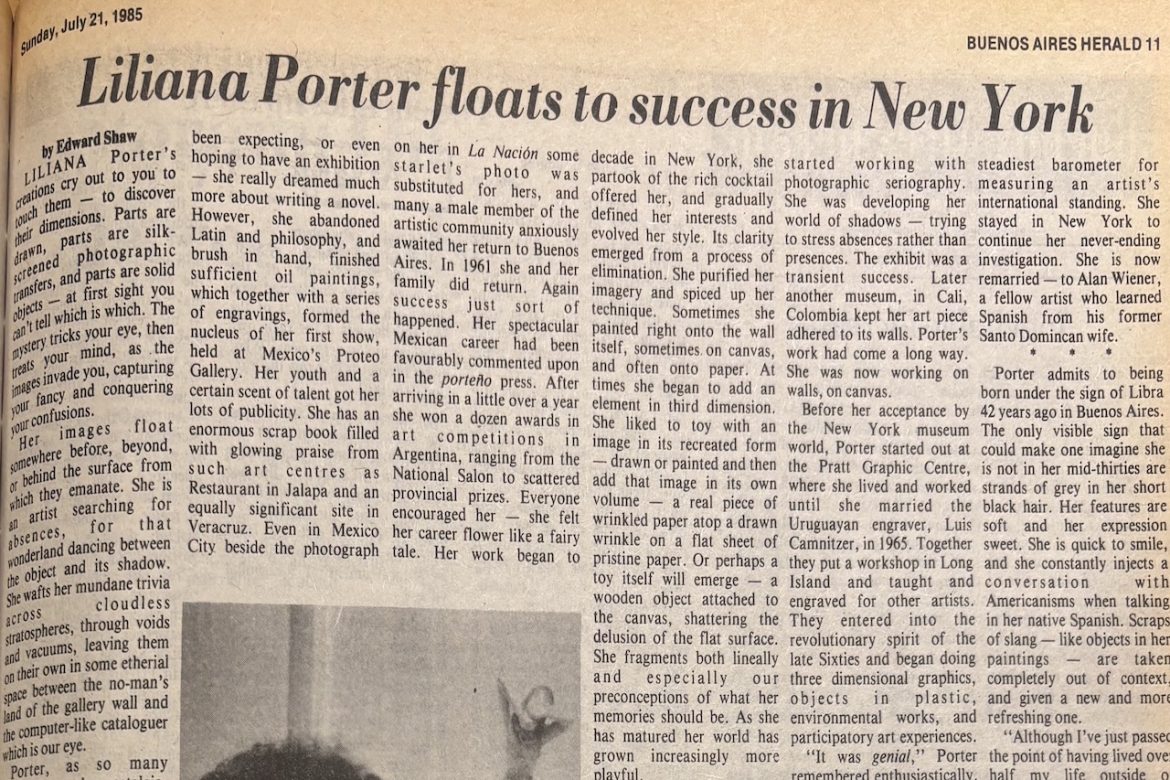
 Buenos Aires Herald
This article has been slightly edited for online publication. You can read about Liliana Porter’s current exhibit here.
Liliana Porter creations cry out to you to touch them — to discover their dimensions. Parts are drawn, parts are silkscreened photographic transfers, and parts are solid objects — at first sight you can’t tell which is which. The mystery tricks your eye, then treats your mind, as the images invade you, capturing your fancy and conquering your confusions.
Her images float somewhere before, beyond, or behind the surface from which they emanate. She is an artist searching for absences, for that wonderland dancing between the object and its shadow. She wafts her mundane trivia across cloudless stratospheres, through voids and vacuums, leaving them on their own in some ethereal space between the no-man’s land of the gallery wall and the computer-like catalogger which is our eye.
Porter, as so many Argentines, evokes nostalgia. Each of her compositions is a compilation of bygone tidbits echoing tales of times only partially recalled. She dangles these articles of her present recollection of a make-believe past before us, juggling them about the surface never letting them fall out of context, or out of the other necessary to transmit her mercurial message. She didn’t start this way, although her story is that of a lady who seemingly floated into her own success in a city as demanding and difficult as New York.
When Porter was slipping out of childhood in Buenos Aires, she overheard her mother and her aunt deciding her future. The choice apparently between starting to be a teacher or initiating the long road to becoming an artist. As her family’s connection with the arts was literary rather than plastic, perhaps both ladies were more intrigued with having a painter in their future. It was decided that at twelve Liliana would start at the Fine Arts academy. Her grandfather had a printing and publishing business. Her father, Julio Porter, and her cousin, César Tiempo, were writers and film directors.
Stumbling into success
Porter’s fortunes in life just seem to happen to her. Somehow success stumbles over her as she is happily plotting along wrapped up in her preferred project of the moment. She had not been expecting, or even hoping to have an exhibition — she really dreamed much more about writing a novel. However, she abandoned Latin and philosophy, and brush in hand, finished sufficient old paintings, which together with a series of engravings, formed the nucleus of her first show, held at Mexico’s Proteo Gallery.
Her youth and the certain scent of talent got her lots of publicity. She has an enormous scrapbook filled with glowing praise from such art centers as Restaurant in Jalapa and an equally significant site in Veracruz. Even in Mexico City beside the photograph of a young girl who seemed somehow to belong on the society page appeared a number of art reviews which somehow seeing through the stiff realistic art she practiced when most girls her age were at her dressers and boutiques, foresaw the budding talent in this pretty, developing artist.
Her relationship with writing did advance her career — she illustrated articles and books for writer friends and idols, ranging from a Neruda poem to a tribute to Alfonso Reyes by Borges, published in a Mexican newspaper. One Mexican critic referred to her as the cañonazo of the season, and so Porter in a pair of years bloomed from Bellas Artes into a Mexican artistic bombshell.
The image was transmitted to Buenos Aires — in an article on her in La Nación some starlet’s photo was substituted for hers, and many a male member of the artistic community anxiously awaited her return to Buenos Aires. In 1961 she and her family did return. Again success just sort of happened. Her spectacular Mexican career had been favorably commented upon in the porteño press. After arriving in a little over a year she won a dozen awards in art competitions in Argentina, ranging from the National Salon to scattered provincial prices. Everyone encouraged her — she felt her career flower like a fairy tale. Her work began to evolve, and she began to find an image and a language of her own, abandoning the more classical figurative style she had learned to interpret in Mexico.
In 1964 she planned to go to Europe to continue her studies and further develop her work. Somehow she was sidetracked and settled in New York — where she has been for the last 23 years.
Her timing was impeccable — besides the World’s Fair, Pop Art and it’s perpetrators were just appearing, stretching the confines of what could be considered fine art. She discovered the incredible wealth of materials available to the artist. She succumbed to the stimulus of gallery and museum shows. The importance given to engraving helped consolidate her decision. Daring her first decade in New York, she partook of the rich cocktail offered her, and gradually defined her interests and evolved her style. Its clarity emerged from a process of elimination.
She purified her imagery and spiced up her technique. Sometimes she painted right onto the wall itself, sometimes on canvas, and often onto paper. At times she began to add an element in third dimension. She liked to toy with an image in its recreated form — drawn or painted and then add that image in its own volume — a real piece of wrinkled paper atop a drawn wrinkle on a flat sheet of pristine paper. Or perhaps a toy itself will emerge — a wooden object attached to the canvas, shattering the delusion of the flat surface. She fragments both lineally and especially our preconceptions of what her memories should be. As she has matured her world has grown increasingly more playful.
Once again luck followed Porter north. The Museum of Modern Art of New York invited her to make a one-woman show in its ongoing series of exhibits entitled “Projects”. A fortunate combination of circumstances coincided — it was the Engraving Department’s turn to choose an artist, she was female at a time when that now unsilent majority was emerging, she was Latin American, but not too much so… at the time of the Alliance for Progress, and she really did have talent. Also she had invented an innovation, and the MoMA as always aimed to be first to the fringes of creation. Her new technique was a bit expensive, because the museum had to repaint the walls after the show, and at the same time destroy the original artwork, but the idea seemed to merit it’s built in destruction.
“Thanks to an idea the saints brought me,” Porter reminisced, by means of a “sophisticated stencil,” she transferred her tale directly to the museum’s walls. Instead of making her silk screen seriographs on paper, she devised a method to do them directly onto the walls. “No one thought of it before. It’s like eating — everyone does it at a table, but it can be done standing up, too.”
The museum show featured her now very realistic images. She had started working with photographic seriography. She was developing her world of shadows — trying to stress absences rather than presences. The exhibit was a transient success. Later another museum, in Cali, Colombia kept her art piece adhered to its walls. Porter’s work had come a long way. She was now working on walls, on canvas.
Before her acceptance by the New York museum world, Porter started out at the Pratt Graphic Center, where she lived and worked until she married the Uruguayan engraver, Luis Camnitzer, in 1965. Together they put on a workshop in Long Island and taught and engraved for other artists. They entered into the revolutionary spirit of the late ’60s and began doing three-dimensional graphics, objects in plastic, environmental works, and participatory art experiences.
“It was genial,” Porter remembered enthusiastically. Despite her decades abroad, Porter spices her exclamations with the more succinct Spanish terms of her childhood. And she managed to keep her ties with Latin America, preparing exhibits for Mexico and Chile.
In 1975, Porter and her husband bought an old house in Lucca, Italy, and started a summer Art School. During the three summer months they trained a dozen artists in etching, photography, and seriography. In New York she had started with the 100 Acres Gallery in 1973 where she was able to lose the stigma of being a Latin American artist — the surname Porter also complicated rapid identification. The owner of the gallery allowed her total freedom. As she started in the period in which conceptual art was at its peak, her combination of classical images with conceptual overtones meshed perfectly with the gallery’s intentions and directions.
In 1978, she regained recognition in Buenos Aires by winning the Critics Prize — given by a jury of international art critics in Buenos Aires for the annual meeting of their society. Her work was, as a local magazine described it, “a row of nails painted on the wall, connected by strings to another row of real nails hammered into the floor.” In 1980, Porter was awarded a Guggenheim grant — the steadiest barometer for measuring an artist’s international standing. She stayed in New York to continue her never ending investigation. She is now remarried — to Alan Weiner, a fellow artist who learned Spanish from his former Santo Dominican wife.
“Mi identity is Argentine”
Porter admits to being born under the sign of Libra 42 years ago in Buenos Aires. The only visible sign that could make one imagine she is not in her mid thirties are strands of gray in her short black hair. Her features are soft and her expressions sweet. She’s quick to smile, and she constantly injects a conversation with Americanisms when talking in her native Spanish. Scraps of slang — like objects in her paintings — are taken completely out of context, and given a new and more refreshing one.
“Although I’ve just passed the point of having lived over half my life outside of Argentina, my identity is Argentine,” she says. She would like to receive her consecration as an American artist, which is being invited to the Annual Show for American Artists at the Whitney Museum.
“Here one can invent the city one wants — the only limit is oneself. There is everything. Not the psychosis of the no as in Buenos Aires, where the telephone, the lack of imported paper, and of other materials becomes a justification for a limited life.”
Porter has integrated into New York — her city is her home and she surrounds herself with all the materials and machines she needs to produce her art. Her own works are accompanied by a lithograph by Steinberg, a small print by Dalí, a work of Lichtenstein, and a life-size figure of Einstein — all these set onto white, white walls and immersed in a feeling of tranquil tension, in which work creates lives of harmony and growth.
Liliana Porter is a slate-of-hand artist who has progressed by nailing her dreams to the floors of museums and has prospered by showing us the shadows of her fantasies. The spaces in her day dreams are woven like lace into fanciful patterns. She creates by subtracting. She captivates us with her often invisible world, where space tells a silent tale.
